
Parijaat Under Breach
An Overview
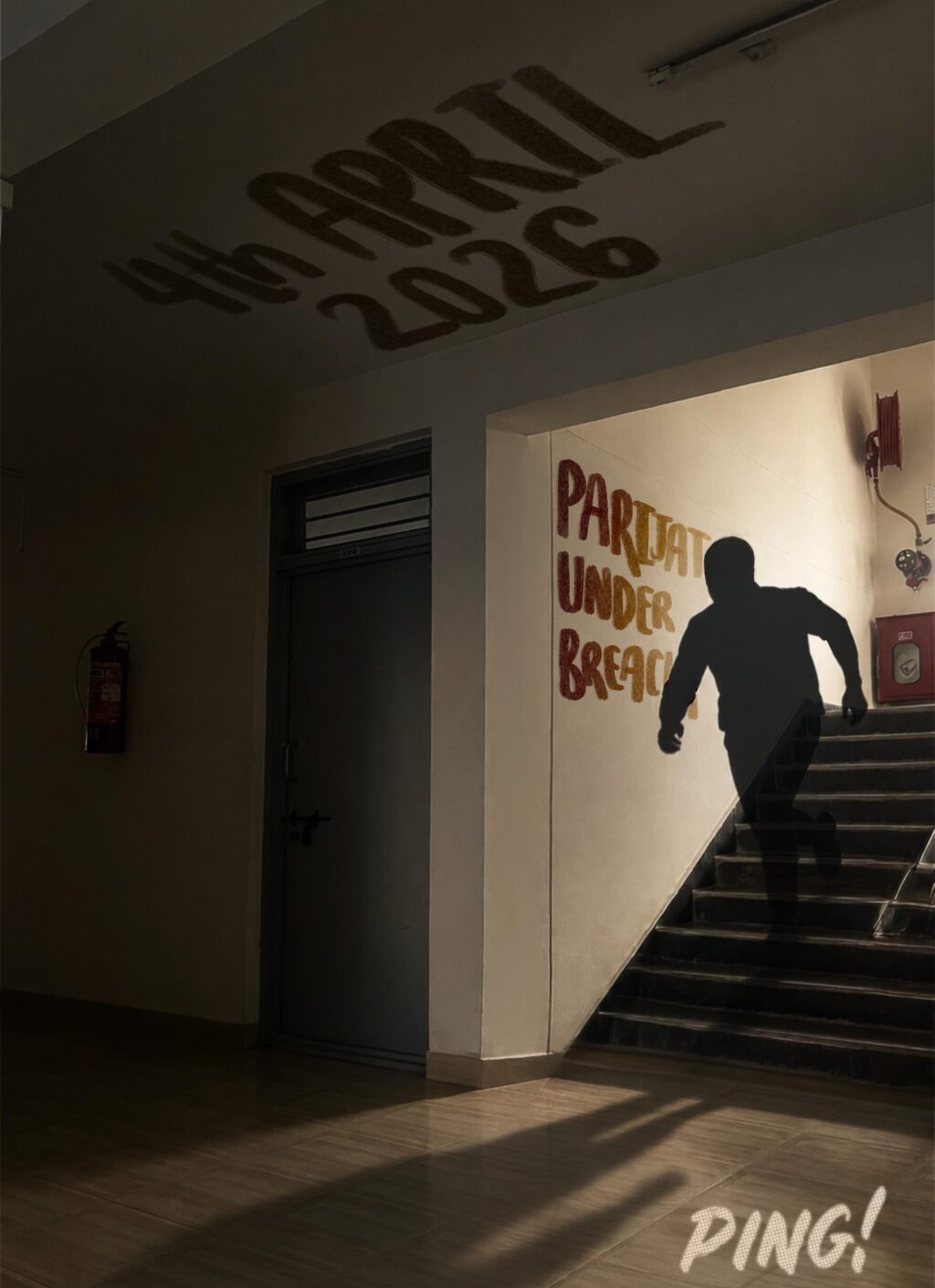
A serious breach of security occurred at Parijaat Nivas and the surrounding areas on the night of 4 April. The problems revealed by the incident are three-way – spanning institute security, gender issues and substance abuse.The details of the incident are present in two sections – under the ‘DisCo Hearing’ section, and the ‘Eyewitness Account’ section. On the night of 4 April, around 9 p.m., a male student (addressed as X, real name not revealed) had infiltrated into the girls’ hostel, entering the B block. Minutes before entering, the student had hurled objects at passers by on the street. Another student (addressed as Y, real name not revealed) followed X into Parijaat, along with a male Aarogya staff member, and attempted to restrain him. X was eventually brought out of Parijaat, escorted to his hostel and removed from the campus premises by the next day. In the immediate aftermath of the incident, there was speculation of physical assault on the security guard stationed at the B block, which was later found to be false in the hearing of the Disciplinary Committee. Ping! attempts to piece together the details of the incident, its aftermath and the significant decisions that were made in this period.
The then-Chair, CoW visited the female students shortly after the incident, at about 12 a.m. in the night. The residents of the B block of Parijaat Nivas sent a mail on the Life List detailing their experience of the incident and points that they wished to raise. Y also circulated his statements on the incident on WhatsApp groups of IIIT students.
In the evening of 5 April, that is the day after the incident, an FSIS was convened, specifically for female students. The faculty in attendance were the Director, Registrar, Dean of Student Affairs, the then-Chair CoW, Parijaat Hostel Warden, Chair of the Institute Security Committee, Head of Campus Facilities and Services, and the Chairs of the Gender Sensitisation Cell and the Gender Grievance Cell. The coverage of the FSIS can be found on the Ping! website.
Following the FSIS, it was concluded that a police case must be filed, and this was done in due course despite initial scepticism from faculty. Certain security measures had also been discussed in the FSIS. The Institute Security Committee had been reconstituted soon after the incident, and it conducted two meetings. The Speaker of the Parliament informed Ping! that the new Security Committee, headed by Prof. Indranil Chakrabarty, has 6 members and two student representatives (one male, one female) from the Student Parliament.
By 6 April – the morning following the FSIS – the Disciplinary Committee was constituted. The investigation of the DisCo is detailed below under the section titled ‘DisCo Hearing’. On the same day, the Security Committee had its first meeting. The Chairs, GSC and GGC, conducted a sensitisation session for all students that evening, covered by Ping!. In the weeks following the incident, the Security Committee convened again. The outcome of both meetings is detailed under ‘Security Measures’.On 7 April, there was a low-profile meeting between female students and female faculty.
DisCo Hearing
The Disciplinary Committee for the hearing on this incident had been constituted by the morning of 6 April, with Prof. Radhika Krishnan announced as the Chair. A representative of Ping! met with the Chair on 23 April, days after the proceedings and submission of the report. Details regarding the incident and the decisions of the DisCo are from said meeting, and can be found under the section titled ‘The DisCo’s Account of the Incident’.
The DisCo collected depositions and CCTV footage, and asked the complainant and defendant to write statements after the proceedings. As per usual procedure, the identities of the parties were not revealed. However, X sent mails to various groups, including the residents of Parijaat Nivas and the wardens, revealing his identity. Note that the parties of a DisCo hearing are not supposed to interact by any means external to the committee. Thus, X’s mail ID was blocked. He was escorted to and from all meetings by a guard.
The penalty awarded by the DisCo was the following.
- One-year rustication, that is, for the semesters Spring 2026 and Monsoon 2026.
- A permanent hostel ban.
Following the hearing, an appeal had been submitted by X, pleading for permission to write the end-semester examinations of the Spring 2026 semester. The appeal was rejected. His re-admission to the Institute is conditional, subject to the discretion of the Institute.
The DisCo’s Account of the Incident
On the night of 4 April, X was seen throwing stones on the road outside the Old Parijaat Gate, which leads to the Main Block. Y was at the bench outside the Main Block, on a call. Meanwhile, X attempted to enter the Main Block, at which point Y noticed him, and followed with the intent of stopping him. Both of them reached the door of the Main Block. There, they were both promptly denied entry, as per general procedure when a male student attempts entry into the girls’ hostel.
After exiting, X proceeded forwards along the road. Y was still pursuing him. X hurled a brick at a delivery driver, who narrowly missed being hit. At this point, he had reached the ambulance that was parked outside Parijaat, and attempted to vandalise it. He entered through the white gate outside Aarogya. Y, who was still following him, entered Aarogya in order to try and restrain X. At this point, X made his way through the black gate.
Note that the black gate is the point beyond which male students are not permitted to enter. Two UG1 students (a male student and a female student) were present near the black gate. Both of them entered through the black gate and attempted to lock X out to prevent his infiltration. However, there was a cloth obstructing the complete closure of the black gate. X could thus make his way through the black gate. The female UG1 student managed to return to her hostel room. At this point, the UG1 male student also attempted to enter the A block for safety. He was promptly denied entry and, as per procedure, the guard situated at the A block bolted the door. Shortly after, X tried to force entry through the A block, and was unsuccessful in doing so because the guard had already bolted the door. Concurrently, the UG1 male student had attempted to enter the B block, but was stopped. The guard at the B block seemed to make an attempt to latch the door, but did not latch it. Subsequent investigation at the site revealed that the door was in a condition to have been latched without a problem, but this was not done. With the door left unlocked, the guard returned to the chair outside the B block. Shortly after, X entered through the B block door, and was not stopped by the guard. Inside the B block, he went towards the washroom area, and then returned and took the stairs. Details of the occurrences on the higher floors of B block are not available in the form of CCTV recordings, but were collated through triangulating evidence. The guard in the B block instructed the female students to stay within their rooms.
In the intervening period (when X crossed the white gate and then the black gate, and attempted to enter the A block), Y had called the NBH security for help. However, they were not responsive. Y had then called the Dean of Student Affairs regarding the matter. Eventually, he also entered through the black gate with a male Aarogya staff member, in order to restrain the infiltrator. Y and the aide then entered the B block, and were not intercepted by the guard. Thus, 3 males entered the B block of Parijaat Nivas without being stopped. This was in violation of security protocol.
A few minutes later, the B block security guard was seen interacting with the other security guards. Eventually, X was restrained and brought down. X was compliant when he was escorted to his hostel by a guard in order to pack his belongings a few hours after the incident. He was made to leave the campus the next morning.
X was under an influence, and had no recollection of the events or his actions during the incident.
Regarding physical assault on the guard
The Disciplinary Committee found no evidence of physical assault claimed by the female security guard at the B block of Parijaat Nivas.
An abdominal CT scan was conducted, and it did not reveal evidence of assault. The guard returned home soon after the incident and was removed from her position due to dereliction of duty and misrepresenting facts.
Police case
A report to the police had been filed, and the police acted upon it as per their procedures.
Eyewitness Account
Ping! spoke with two students (addressed as P and Q, real names not revealed), residents of the B block of Parijaat Nivas, who witnessed the incident. Note that three areas will be mentioned in the detailing – the stairs, the left of the staircase, and the right of the staircase.
P and Q were previously outside Parijaat Nivas, and the door to P’s room was locked. At the time when X was in the B block, P and Q entered the B block from outside, and were walking up the stairs inside with another student. The students reported witnessing no chaos in this period. On the way up the stairs, both of them saw a group of B block residents running back to their rooms. Having ascended the stairs, P accompanied the third student to her room [left of the stairs], and was there for a short period of time. Concurrently, Q was to the right of the stairs.
At this time, Q noticed three men, who she assumed might be workers. Q noticed the three men (X, Y and the aide). She noticed X attempting to enter P’s room by unlatching the door and putting a foot inside, and subsequently being pulled out by Y. She then recognised Y to be a student, and he told her to go back to her room.At
At this time, P came out of the room she was in, and noticed the three people (who she later learnt were X, Y and the aide) running down the stairs. She noticed that her room door was no longer latched but was wide open. Q informed her about what happened in the interim.
Security Measures
In the Security Committee meeting on 6 April, certain actionable items were discussed. This meeting was also open to concerned students not in the Parliament. These points were taken up again in a follow-up closed-doors meeting, attended by the Members and three representatives from the Student Parliament. The Speaker and the Joint Hostel Secretary of the Student Parliament briefed Ping! about the meetings. The summary of these discussions is presented below.
- In the light of the incident,
- Increase the number of guards at the black gate and old Parijaat entrance.
- Security patrolling once every 30 minutes at the hostels and other critical areas.
- Plan of action within two weeks of the incident. Implementation of immediate-action items in a month.
- For cases of emergency and preparedness of security, the following provisions will be made.
- An ‘emergency bell’ to all guards and faculty, as dialling a number takes time. Additionally, a standard protocol would have to be developed to come into effect if the button is pressed.
- Deployment of an emergency number. Calls will go to an always-on-duty main gate supervisor.
- Development of emergency Standard Operating Procedures (SOPs), with timely revision.
- Walkie-talkies to the guards for easy communication.
- Pepper sprays and lathis to the guards.
- Longer shifts of guards.
- Self-defence, fire and first-aid training workshops for security.
- Regarding increasing CCTV monitoring,
- Greater CCTV coverage at the entrance and at areas like Parijaat badminton court, building entrances and road intersections.
- Installation of a 360o camera at the main gate.
- Passive monitoring approved, with access given only to the Registrar, IT Head and Chair of the Security Committee.
- In relation to visitor and campus-entry management,
- A proper Visitor Management System to track pre-booked and on-the-spot visitors, integrated with the Institute Management System.
- Stricter enforcement of biometric registration for students entering / exiting campus.
- Clear division of pedestrian and vehicular traffic at the main gate.
- For medical emergencies, an emergency medical response system for guards would be developed, and a bullet ambulance would be available.
- For hostel safety,
- Possibility of a biometric and turnstile system.
- As mentioned, increased patrolling.
- Two-way locks in hostels.
- Infrastructure improvements such as,
- Higher barbed wire fencing at the JC area.
- Increased lighting at key areas in the campus.
- Better fencing in the Felicity Ground and construction areas.
- Points were considered regarding detecting substance abuse.
The Speaker of the Student Parliament stated that the immediate-action items discussed included introducing a bike ambulance, installation of security posts at key areas, lighting improvements, CCTV installation and emergency response and management. The security posts have been set up at the entrances to Parijaat Nivas, but notably, as of the date of completion of this article (~7 weeks since the incident), many of these items have not been fulfilled.
Conclusion
The incident highlighted several problems in the campus – institute security, safety of female students and preparedness in the case of emergencies. While these issues were discussed at length in the days following the incident, an honest audit of the current situation is required to ensure that the measures have not merely been reactionary and reflect a real change.

 A Tribute to Oreo
  The Summer I Didn’t Do Enough
  A Game of 3s, 2s and 32s
  Terminal 3
  It’s Really Not the End of the World
  Strangers in the Night