
UGEE: Thinking? In this economy?
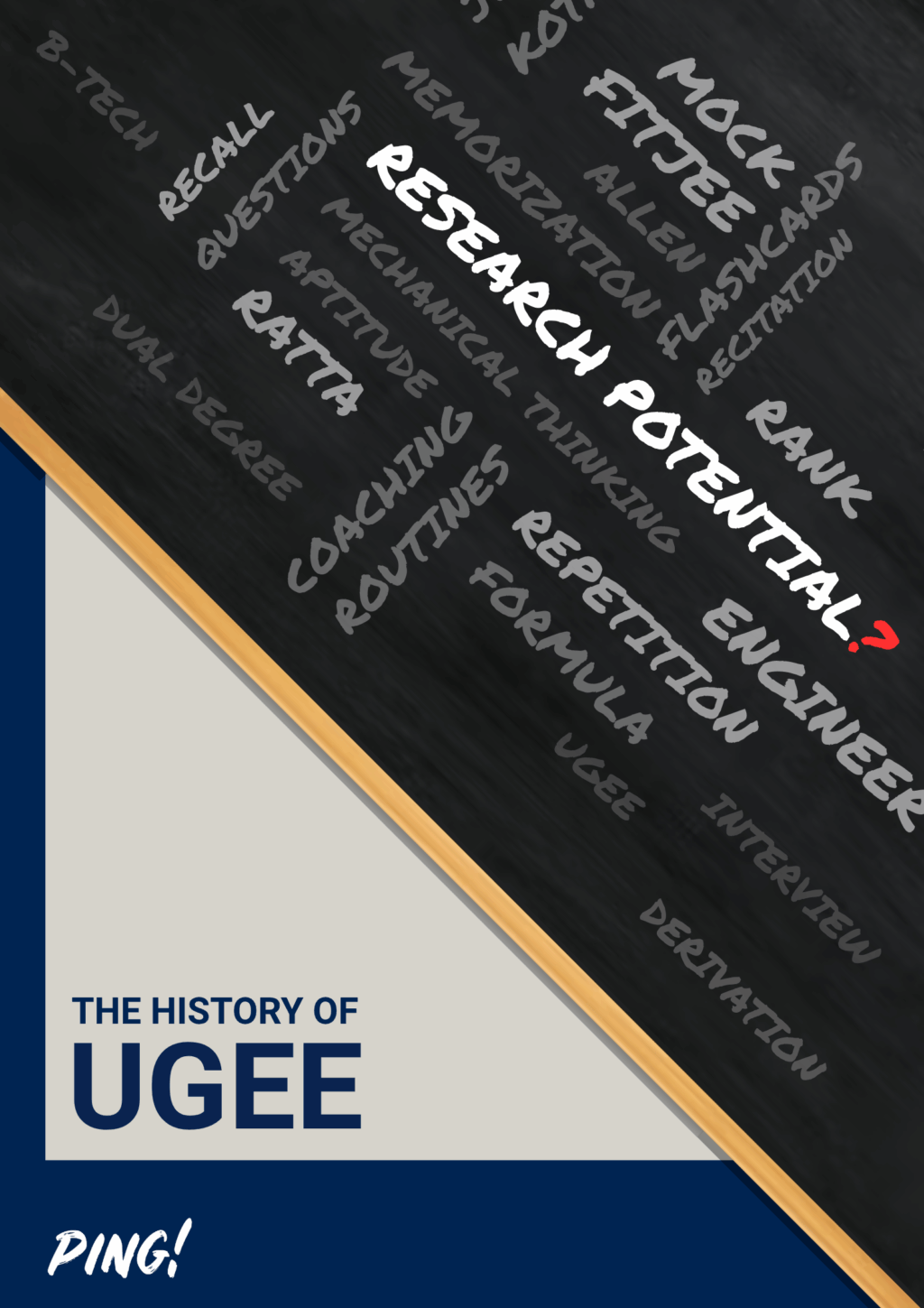
High school. It’s supposed to be a time of joy, personal growth, and learning. In India, it’s not. It’s been ruined in many ways by the education system, whose focus on rote learning has eliminated almost any opportunities for growth or enjoyment. Students are crammed into institutes which have only one goal in mind: ranks.
Classrooms become pressure cookers, where curiosity is replaced by coaching, and exploration is sacrificed in the name of entrance exams. Students are no longer seen as individuals with personal interests or talents. They become statistics, rank-holders, cut-off clearers. If you’re not good enough, you’re pushed to the sidelines, so the focus can be given to the “star performers.” The focus shifts from “Do you understand the topic?” to “How IIT?”. Most of us have been through this, writing at least half a dozen entrance exams, hoping that we can one day become “engineers.”
Among this myriad of entrance exams, IIIT wanted to do something different for their dual-degree students. To know why, we spoke with Prof. Jayanthi Sivaswamy from IIIT, the Dean of Academics at the time UGEE was launched and one of the architects of the exam. She aptly summarized the need for a different type of exam, “A student who can crack competitive exams may not be the best student to do research […] We wanted to test open-ended thinking. The average student is highly coached. They may know the formula, but do they know why it works?”
IIIT wanted a mode of entry which is able to break the barrier of the normal rote learning-based examination; they wanted students who asked “why?” instead of just “what?”
And so, in 2018, a new mode of admission to IIIT was born: UGEE. While it does test PCM, that isn’t the focus. Two-thirds of the paper is tailored to logical thinking. Something you can’t really prepare for.
But it’s India, nothing goes uncoached for too long.
UGEE gained popularity, and institutes started offering courses for it. Most UGEE students receive at least a few phone calls every year from students, curious as to how they cracked this exam. “We’re probably not getting the truly research-inclined students anymore,” said Prof. Jayanthi. “Just those who don’t mind research.” It’s hard to blame the students though. When the system forces you to play the game, you try to get good at it. And even a test designed to be un-gameable slowly just becomes another level who’s PYQ’s you need to grind.
Luckily, UGEE has a second layer, one that’s much harder to fake: the personal interview. Only about 750 students make it past the rigorous written exam to get to this stage. Each of them has an admission interview with a panel of IIIT professors. “The interview is our trump card,” Prof Jayanthi said. “I could clearly see the difference between a highly coached student and one who was not.”
The intent of the interview is not to mass reject students who can’t answer the strange questions put forward. It’s more about seeing how you respond when faced with a problem completely unlike anything you’ve encountered before. Do you pause? Think? Ask good questions back? Do you try anyway even though you have absolutely no idea if you’re right? Or do you retreat into silence, trained to believe that saying “I don’t know” is a sin? As Prof. Jayanthi puts it, “We ask deceptively simple questions that probe fundamental understanding. We want to see what happens when we throw a student into an arena of things they don’t know.”
And if you mess up? Most people think they messed up their interview. I’m yet to meet anyone who thinks theirs went more than “ok.” Yet, they get admission. The panel isn’t looking for polished, coached answers, they’re looking to see if you can think for yourself.
Another thing UGEE attempted to do, more on the personal side of things, was to break the divide between the single and dual degree students. Back when all admissions took place through JEE, the cutoff for the BTech programs was higher. This led to the dual degree students feeling inferior. The exam was meant to give the students whom it admitted a different identity. These students were even then given @research.iiit.ac.in email addresses, hoping that they wouldn’t be directly compared to their single degree counterparts. “They were part of the research class”, as Prof Jayanthi put it.
From its very inception, the aim of the dual degree program was to nurture a pool of students genuinely interested in research at the undergraduate level. It is a testament to the belief that curiosity and critical thinking aren’t skills that magically appear during a PhD, but can be fostered from the start, if students are given the right support and encouragement. The program was never about creating backups for BTech; it was about creating a pipeline of researchers who thought differently.
Did it work? Well, on the identity front, there was still the assumption that those who enter through UGEE are just there because their JEE ranks weren’t high enough. But mostly we’d say it did work. Apart from the occasional jokes that CNDs will never graduate (most of which are made by DD’s), it’s a non-issue here. And as for cultivating a class of world-class researchers at the undergraduate level, it seems to have worked as well. Both Professor Jayanthi and Prof. PJ Narayanan, the Director of IIIT, remarked that both research quality and interest in research has increased substantially since the introduction of UGEE. Students, to a large extent, don’t see the masters thesis as an impediment to their graduation, but rather an opportunity to discover something new or learn something more.
Overall, UGEE was intended to be an entrance exam which tested critical thinking and research aptitude, not memorization. It was created to find research-oriented, inquisitive students who had not been broken by the system of rote learning. However, despite this intent, UGEE is often misunderstood. Many view it as a backup if JEE goes bad or as just another path into IIIT. As a concluding message, Prof. Jayanthi advised parents and students alike, “please don’t think of UGEE as an alternative entry-point to IIIT. It is meant to be a channel for truly curious minds.“


 A Tribute to Oreo
  The Summer I Didn’t Do Enough
  A Game of 3s, 2s and 32s
  Terminal 3
  Parijaat Under Breach
  It’s Really Not the End of the World
  Strangers in the Night
Very interesting article. IIIT H students are amazing