
Beyond the Black Box: IIIT’s New Chapter with Professor Sandeep Shukla
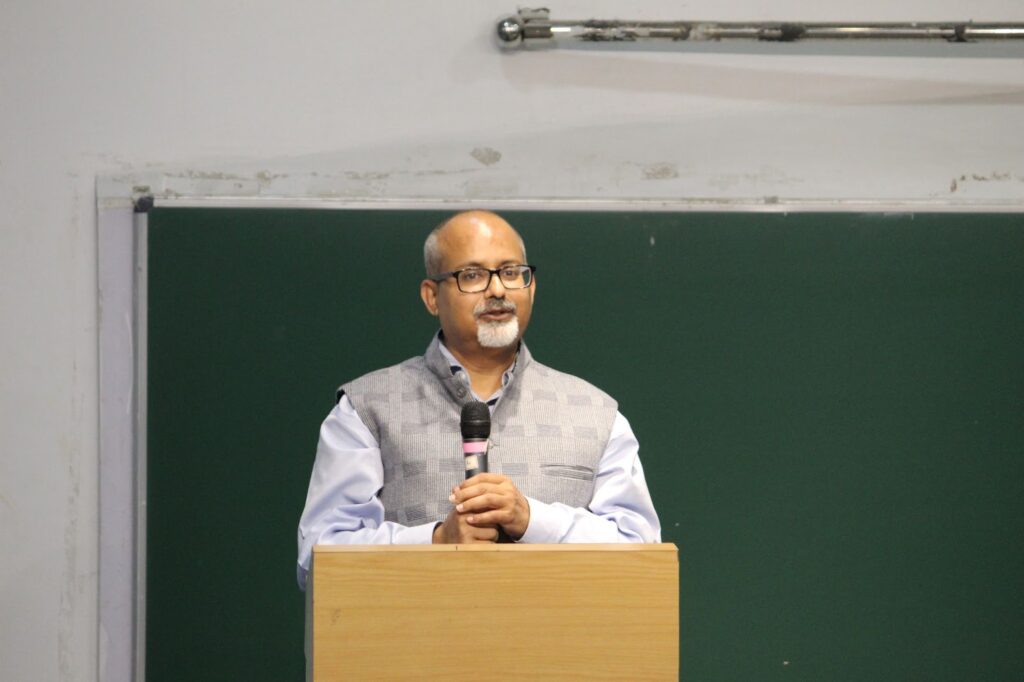
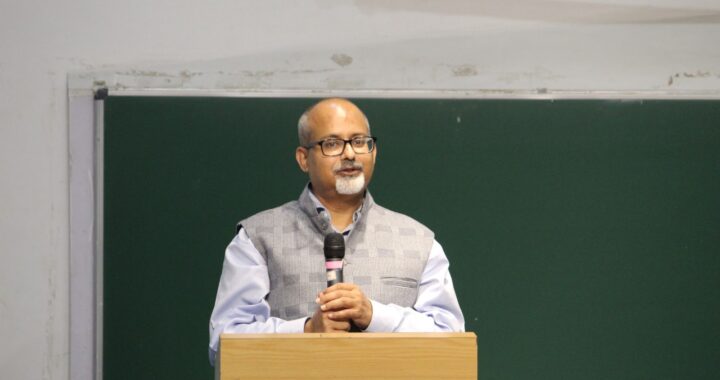
As Professor PJN departs as director, IIIT Hyderabad begins a new chapter in its history under the stewardship of Professor Sandeep Shukla. Professor Shukla is a new face to almost all of us, coming from IIT Kanpur to take up the directorship. So, Ping! sat down with him to understand his vision for IIIT.
The Journey to IIIT
To start, we asked him about his journey thus far. After completing his Ph.D at the State University of New York at Albany in the United States, Professor Shukla worked in industry for a few years – first at a telecommunications lab, followed by Intel. However, he quickly realized he had a passion for teaching and that led him to venture into academia. First, he spent a year at the University of California at Irvine before moving across the country to join Virginia Tech, where he would go on to spend the next 13 years as a faculty member.
At Virginia Tech, Professor Shukla transitioned his research focus from formal verification to the security of power systems, simulating how communication systems can be attacked in real-time. Around this time, frequent hacks of critical infrastructure, such as a steel plant in Germany and a dam in New York, sent shockwaves around the world. All of a sudden, the technology that humanity had become dependent on became a major vulnerability. This made Professor Shukla’s work increasingly important as cybersecurity went from a theoretical research domain to a mainstay of computer science.
On a visit to India sometime in 2015, Professor Shukla pondered about the state of cybersecurity in India. To his dismay, it was practically nonexistent. He remarked, “the computer scientists were doing more on cryptography, and the power system guys were doing power system control,” with no collaboration between the interlinked fields.
Seeing the urgent need for cybersecurity research in India, Professor Sandeep Shukla penned a proposal to the Department of Science & Technology to create a center for cybersecurity.
This led to the creation of the National Interdisciplinary Centre for Cyber Security & Cyber Defense of Critical Infrastructures (C3i Center) at IIT Kanpur. Recruiting a team of engineers with a background in industrial automation, they got to work building a center which quickly rose to the top of the Indian cybersecurity scene. A few years later, in 2019, the government started a mission on interdisciplinary Cyberphysical Systems and as part of this mission, the C3i Center became C3iHub. C3iHub was then empowered with substantially more funding to research and design secure systems for India’s national security.
However, after 10 years at the helm, Professor Shukla mentioned that he either wanted to do “a cybersecurity related activity or [take on] a bigger role where [he] can go beyond cybersecurity into other technologies as well.” Thankfully, around this time, IIIT Hyderabad had opened up applications for the position of director.
What is Cyber Manthan?
Before moving on to discuss his visions for IIIT as a whole, let’s take a look at Cyber Manthan Center, Professor Shukla’s new cybersecurity center here at IIIT Hyderabad. Instead of just focusing on cyber physical systems like C3iHub does, Professor Shukla wants to leverage IIIT Hyderabad’s strong computer science background to work in cybersecurity.
This focus on practical applications also highlights a break from C3iHub’s work. C3iHub was an almost completely research-focused endeavour. Very few usable products came out of the hub. In contrast, at Cyber Manthan, Professor Shukla aims to collaborate with other organizations, a theme we’ll return to shortly.
The nascent center has already piqued the interest of the Telangana Police. Last September, the Director-General of Police of Telangana, Dr. Jitender visited IIIT Hyderabad to inaugurate Vyuha Labs, a part of the Cyber Manthan Center. The lab’s mission is cleverly placed in its name: Vyuha is a Sanskrit word referring to the “strategic design” or “battle formation.” And this highlights the lab’s focus: developing the vyuha needed to protect India from cybercrime, working on all manner of investigative methods, tools, and techniques.
Asking about cybersecurity as a whole, we also asked the new director about security on the IIIT network. He began by talking about how in major corporations, devices usually have an EDP system which monitors all file changes, downloads, etc. to monitor for anomalous behavior. While such an approach makes the organization very secure, it would obviously not work in an academic institution where faculty like more freedom from surveillance, for example. Instead, Professor Shukla spoke about segmenting the IIIT network such that “people who want a high level of security can be in a more savage network, whereas those who don’t can be in a different network and then these two networks will be segregated by firewall.”
Whether or not this comes to fruition, Professor Shukla mentioned that IIIT must at least formalize a cyber-security policy, something even leading IITs have failed to do.
Opening the Doors
As we discussed above, IIIT Hyderabad has often been an enigmatic black box, doing world-class research but seemingly disconnected from its surroundings aside from its manpower contributions to Big Tech.
To that end, Professor Shukla’s tenure seems to mark a change in IIIT’s vision. He put considerable emphasis on how he wants to “create proper channels of outreach” to “bring innovations out of the labs into the community, to the government, [and] to the local industry,” echoing Professor PJN’s words. Throughout the interview, he constantly reiterated that IIIT needs increased outreach. One of Professor Shukla’s primary goals is to immerse IIIT in the Indian technological ecosystem, whether that be in cybersecurity, robotics, or any other domain.
Of course, we can’t do it alone. That’s why Professor Shukla also mentioned reaching out to other higher education institutions; “I think that cross-organization collaboration would obviously enrich the students, give more opportunities.” Some institutes he brought up included familiar names like ISB and IIT Hyderabad, but he also emphasized branching out to other institutions like IDRBT, RBI’s training and research center which is also located in Hyderabad.
Building a Legacy
And what about the impact of all this on us, the students? Professor Shukla also spoke on the important role of student culture in transforming IIIT from a mecca of theoretical research to a testament to Indian ingenuity, providing indigenous solutions to the country’s biggest issues. He mentioned how, while sympathizing with those under financial pressure to earn money after graduating, those of us who are financially comfortable should “come forward and do something” for the betterment of Indian society.
While the administration has often made statements like these, many alumni have been quite frustrated by how disorganized IIIT’s alumni outreach efforts are. On the surface, the institute encourages entrepreneurship and making a difference. But in reality, the support received is lackluster and the networks practically nonexistent. Professor Shukla acknowledged both the desire of alumni to give back and also the lack of institute support in many cases. Furthermore, he expressed interest in creating a stronger, tighter network of IIIT alumni who don’t just disappear as soon as they get their degrees.
All of this is part of Professor Sandeep Shukla’s push towards India’s technological sovereignty. He mentioned that for too long have our best engineers been siphoned off to other countries and India itself dependent on multinationals for modern necessities like communication. His vision is that “we have to have our own operating system, our own cloud system, our own email system, social media, messenger, everything. And if our students can work towards that goal, I think it will make a huge difference.”
The Llama in the Room
All this talk about cybersecurity, technological sovereignty, and alumni networks may be reassuring or inspiring, but it isn’t directly impacting our classes or life. Fear not, for we have also asked Professor Shukla the quintessential question which is on everyone’s minds: what are your thoughts on AI, especially in the classroom?
Professor Shukla recalled a similar dilemma faced by a fellow faculty of his at IIT Kanpur. The faculty in question was teaching the introductory computer programming course and somewhere along the way, he realized that all of his lab questions could easily be done by ChatGPT. So how do you create an environment which teaches students computer programming while still making them ready to deal with the power of AI?
“So, there are two ways to go about this. One is to create a lab in which you deny the internet, deny the phone access and make students do it. And I think that is a wrong approach because students in the real world will not be denied and denied the environment. Rather, I think they can do more interesting projects if they are given access to ChatGPT. They also can ask ChatGPT for explanations of things that they are not understanding.”
The Road Ahead
The transition from Professor PJN’s directorship to Professor Sandeep Shukla’s represents an evolution in IIIT Hyderabad’s core mission. Professor PJN meticulously built the engine of a world-class research institution; Professor Shukla is now ready to put that engine on the road, steering it towards tangible societal impact and technological sovereignty. From Cyber Manthan’s focus on real-world cybersecurity to a renewed emphasis on our alumni network and industry collaboration, the message is clear: the era of IIIT as a ‘black box’ is ending. The call for IIITians is no longer just to excel academically, but to apply that excellence to solve India’s unique challenges.
(As interviewed in August 2025)

 The Great Coupling
  PJN – Professor and No-Longer-Director
  The Lazy Third Eye: 2024-25 Annual Report edition
  The Lazy Third Eye: Reclaiming Student Democracy
  A conversation with SubtasksWhere
  UGEE: Thinking? In this economy?
  Beyond the Black Box: IIIT’s New Chapter with Professor Sandeep Shukla