
PJN – Professor and No-Longer-Director
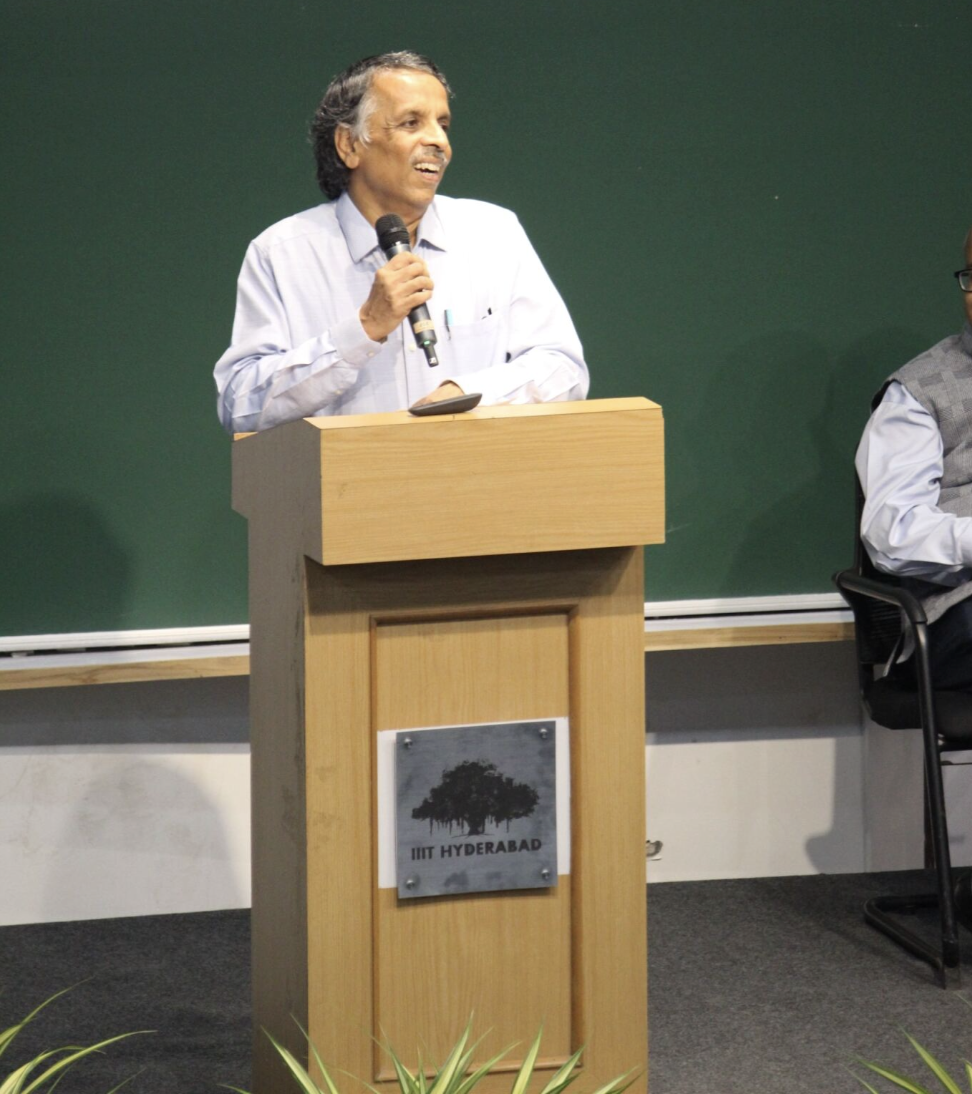
Prof. P.J. Narayanan giving his last speech as the Director of IIIT
Professor Pazhayam Jathavedan Narayanan – better known as Professor PJN – recently stepped down after a transformative 12-year tenure as Director of IIIT Hyderabad, passing the torch to Professor Sandeep Shukla. To almost all members of the IIIT community, this is the first time we are witnessing a transfer of responsibility from one director to another. Ping! sat down with both of the directors to understand the journey of the last decade, the meticulous process behind the transition, and the exciting future that lies ahead for IIIT Hyderabad.
A Look Back: IIIT’s Transformation Under Professor PJN
Describing his directorship as a whole, he stated that he had inherited a stable system with an established culture and ethos. So, his goal was “scaling up the research and improving the quality and improving the numbers.” And improve the numbers he did. Under his leadership, IIIT’s student population doubled and the institute’s budget increased five-fold. Moreover, much of the infrastructure which we now take for granted – such as KCIS and the Himalaya Block – was constructed or completed under his tenure.
IIIT has always held a unique status in Indian academia; “We like to call ourselves as a public institution, not a government institution, neither a private institution.” No government body or private corporation dictates the direction of IIIT’s research and future. This has allowed IIIT to experiment with novel policies rarely found elsewhere. Notably, IIIT has been able to develop new modes of admission such as UGEE. It’s also made the institute versatile in its curriculum, being able to completely overhaul the curriculum every 10 years. However, as no government ministry or private organization is backing it, it also leads to slower growth and continuous funding challenges.
That’s why Professor PJN was so glad that they could erect a building like the Kohli Research Block and that too with minimal cost to IIIT itself. Describing the process, Professor PJN mentioned how the TCS Foundation was generous enough to donate an initial ₹20 crores to kickstart construction and then an additional ₹33 crores to see it through. All of this came with just two simple conditions: “[the first is that] it had to be some academic or research based building [and] second is they wanted it to be named for Mr. F. C. Kohli.” For those who don’t know, Mr. F. C. Kohli was the man who brought the software revolution to India. To have a building named after him, and to develop a strong relationship with an Indian tech heavyweight like TCS was an incredible honor for IIIT and Professor PJN expressed enormous gratitude and pride describing the entire ordeal.
However, as I’m sure we’re all aware, not all was sunshine and roses. One of the recurring issues, especially in recent years, was the mess situation. With respect to the mess, Professor PJN mentioned that while “these are not good [things and] they should not happen, these are very peripheral issues. The core issue is how do you get education […] and I am glad or lucky that there were no major setbacks on that front.”
Speaking on the role of the director, Professor PJN said that the role of the director was not about “power and controlling people or telling people to do this and that.” Rather, the director serves as a “force multiplier.” Small decisions made by the director have an enormous downstream effect, whether that means involving certain people in a certain process or altering the timeline for an event by a week.
Passing the Torch: The Directorship Transition
Moving onto the transition, we asked Professor PJN about why he was retiring, and especially, why now? A transition had already been in the works since 2023, when PJN’s second 5-year term as director was due to end. During that summer, the institute rolled out applications for the position of director while PJN stayed on at the behest of IIIT’s new Chairman. As for why he was leaving, Professor PJN remarked, “I think [the] institution needs new things,” specifically “somebody else coming and doing things differently, [bringing] new experiences.” As IIIT continues to grow, its priorities and vision must evolve to account for a rapidly-changing world and its concomitant challenges. And for that, a fresh perspective is necessary.
But how did they land upon Sandeep Shukla? While mentioning that he had no official role in the selection process, Professor PJN walked us through the meticulous steps involved. Initially, a whole host of names from across the world were proposed. Professor Shukla wasn’t even one of the original candidates with his name added “quite late in the process when he had also planned to leave [IIT Kanpur].” However, this last minute addition did not prevent him from being one of the eight shortlisted candidates – comprising six external and two internal prospects. All candidates presented their vision for the institute to the community, and the external candidates visited the campus to interact directly with faculty, students, and staff.
Following these presentations and interactions, feedback was collected from all stakeholders and conveyed to the formal UGC-mandated selection committee. This committee then selected a final shortlist of three individuals, from which the chairman ultimately chose Professor Sandeep Shukla as the new director.
What’s Next?
So what’s next for Professor PJN? He was quick to point out that just because he was stepping down from the position of director does not mean he would be leaving IIIT. “I would like to continue here, doing more teaching and research… and one particular activity where I can be of more help from my point of view is external relations”. As Professor Sandeep Shukla would also later remark, revamping alumni outreach is a big focus of IIIT moving forward. In one of his first engagements as director, both Professor PJN and Sandeep Shukla went to Bangalore to meet IIIT alumni who had taken up entrepreneurship.
More than just alumni, Professor PJN will also be involved in collaborations with industry and other institutes. The guiding vision of IIIT has evolved; doing ground-breaking research is not enough, IIIT is now also focused on applying the aforementioned research in a way that, “Everybody, every section of the society from the policemen to the government officials to the shopkeepers should have some connect[ion] with IIIT.” While IIIT has, under Professor PJN’s leadership, become a mecca for exceptional research in India, there is still room for improvement in actually applying that research. This is something Professor PJN aims to work on after his directorship.
Before wrapping things up, we wanted Professor PJN’s opinion on the rise of AI and what it means for IIIT Hyderabad. First, he mentioned that the rise of generative AI has put the industry in a “state of confusion.” But doubling down on his optimism about IIIT and its unique structure, he mentioned that while trends like virtual reality or generative AI come and go, students with a “sound training of fundamentals” will always excel. He also exhorted IIIT students to embrace the use of AI, stating that “anyone who does his or her work with AI will be ahead of someone who does it without AI.”
Overall, the entire interview was filled with brilliant insights and tidbits about the institute’s history. But what stood out to me was Professor PJN’s response when we asked him if had any regrets about his time as director. He mentioned that, “[when] I see 25 things that I [did] well. I am happy about [them]. I would concentrate on th[ose] more than the 250 things that I didn’t do as well or I could have done.” And I believe there’s a lesson in that not just for the new director, but for all of us.


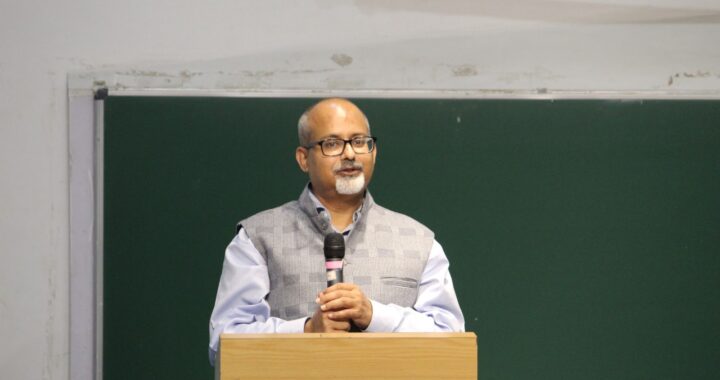 Beyond the Black Box: IIIT’s New Chapter with Professor Sandeep Shukla
  The Great Coupling
  The Lazy Third Eye: 2024-25 Annual Report edition
  The Lazy Third Eye: Reclaiming Student Democracy
  A conversation with SubtasksWhere
  UGEE: Thinking? In this economy?
  PJN – Professor and No-Longer-Director