
A conversation with SubtasksWhere
Humans are naturally drawn towards competition. We cheer on the best javelin throwers, despite it being centuries since people have hunted for food; we watch with bated breath as two people intently push wooden pieces forward; we invest ourself on gameshows based on haphazard conceits. But of what might be of more interest to many of us who are perennially surrounded by algorithms and data structure, is a contest specifically about that; where the best and brightest minds wrack their minds on how to solve some of the most difficult programming questions ever designed.
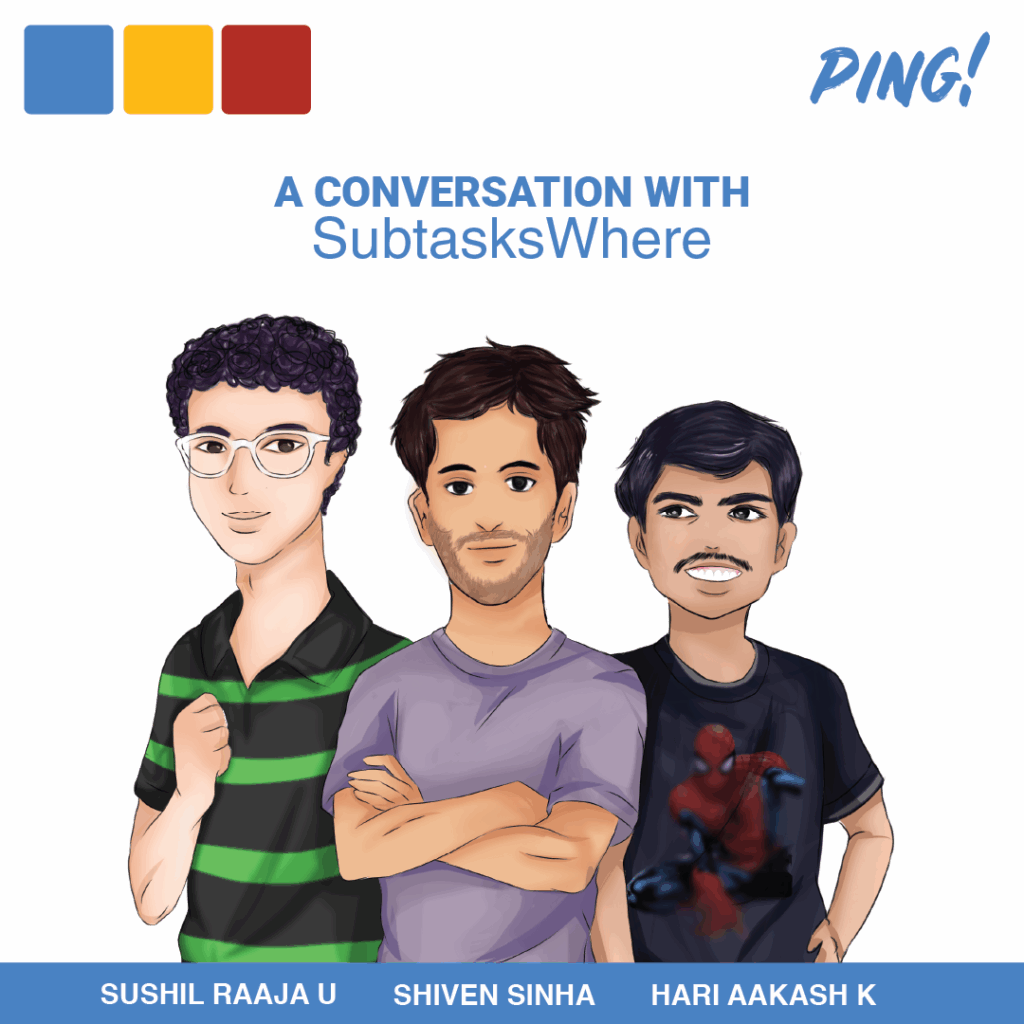
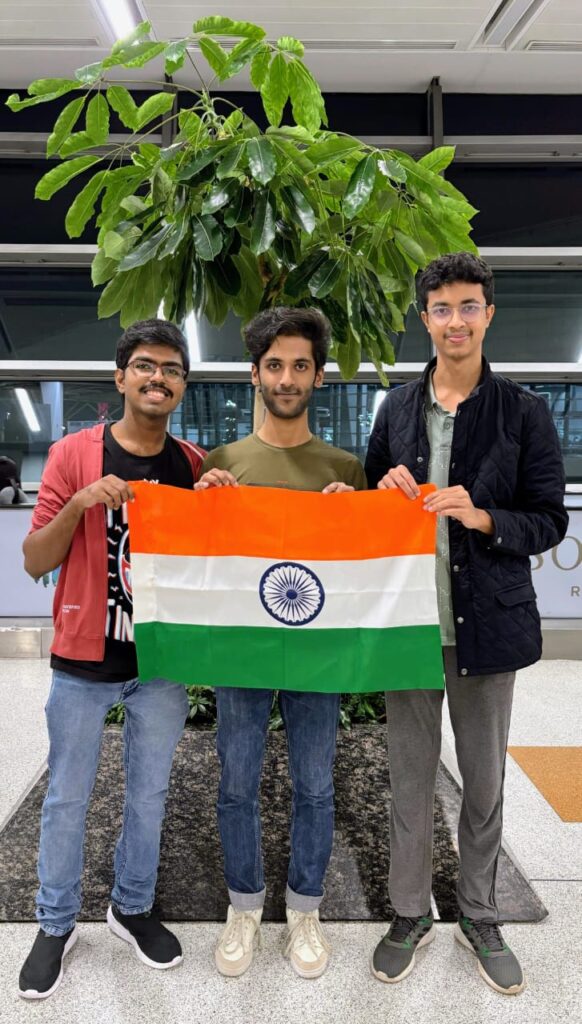
ICPC (International Collegiate Programming Contest), is the most prestigious collegiate competitive programming competition in the world, where teams from universities across the globe vie to test their mettle. This year, representing IIIT Hyderabad in the World Finals at Baku, is SubtasksWhere, consisting of Shiven Sinha (UG5), Sushil Raaja U (UG2) and Hari Aakash K (UG2). Ping! sits down with the trio for an exclusive interview, where we talk about the team’s motivations, preparation and their journey to the centerstage of competitive programming (CP).
The Making of SubtasksWhere
All three members followed similar paths into the world of competitive programming, each being active participants in India’s Informatics Olympiad and qualifying for the IOI Training Camp (IOITC). Their team name, “SubtasksWhere,” is again a nod to their shared history in programming Olympiads. Unlike ICPC, where teams have to fully solve questions in order to earn points, Olympiads have partial points for solving subtasks of the original problem. As Sushil explains with a laugh, “We are just asking where the partial scores from the subtasks went.”
The three of them all first came across CP during their school days, while playing around with topics related to programming. Sushil found himself bored during the COVID lockdown, and started exploring “random stuff related to programming”. It was in this process that he discovered CP, which in turn led to him preparing for Olympiads, and an eventual stellar performance in IOI, winning silver and bronze medals for India in the highest stage.
Initially, Hari dismissed the Informatics Olympiads, thinking it was similar to the run-of-the-mill SOF Olympiads, but an encounter with UFDS, a student-run training program for IOI, kicked off his journey on Codeforces. For him, the prospect of getting into a good college served as an additional external motivation to excel, in a country where academic paths are fairly limited.
For Shiven, the veteran of the team, CP was a conscious pivot from a more traditional path. When his school happened to host a preliminary stage of the Olympiad, he gave an unprepared attempt, but in the process, found the problems deeply interesting. The following year, he completely dedicated himself to his Olympiad preparation, even skipping JEE, for something he found “much more fun”.
Shiven is no stranger to ICPC. Despite being extremely strong coming into college, he struggled to find other teammates of his mettle for the first couple of years. Last year, he finally managed to put together a competitive team, but heartbreak followed in an unlucky elimination. In Hari and Sushil, he says that he found “the strongest people who had come to college in a long time”. The two then-first-years found Shiven’s interest in them a pleasant surprise. “I did not really know that Shiven did not have a team…I always assumed, since he has been in college for some time, he would have a team”, Hari recalls. But their journey afterwards reveals that their coming together might have been the best possible thing for the INOI veterans.
The Road to Baku
SubtasksWhere is an extremely strong team on paper. At the moment of writing, all three members are ranked among the top 15 programmers in India, with Sushil in the top 5. Even in an all-India summer camp, where teams from the best colleges of India — IITs, CMI, BITS — all compete, they consistently placed the highest. But what seemed like smooth sailing into the World Finals ran into quite a bit of unexpected turbulence for the trio.
Their entire campaign almost ended before it even began due to a chaotic qualifying round. They had initially delivered an exceptional performance, which was unfortunately nullified due to server issues. The hastily organized replacement round did not have the same well-crafted questions as the original: to the point that several questions were flawed, and one was outright wrong. The team found themselves struggling on questions that should have been easy for them, and saw other teams passing by with shoddy solutions, and soon found themselves on the brink of elimination. Shiven described his feelings at the moment with one word: “Dread”. “At that point I had almost lost hope…I was thinking about begging the organizers using our previous contest performance”, Sushil admits. However, with only 30 seconds left, Hari pulled off a clutch solve, putting them through. “I think I was trying to submit it and the page was not loading fast enough…30 seconds were remaining and a lot of adrenaline,” Hari recalls.
But the team refused to be bogged down by these complications, and arrived at the on-site Kanpur regionals filled with confidence. However, here they encountered an issue that would bog them relentlessly across their journey – slow starts. The teammates attribute this partly to the fatigue of travelling and adjusting to a new place, making it “hard to get in the zone”. “I have no idea why we were slow; it just happens sometimes…Sometimes you just start out slow and then you eventually catch up”, Sushil posits. And catch up they did, securing the undisputed first place in India and a ticket to the World Finals.
“I think in Kanpur, a funny thing that happened was: towards the end we were left with three problems in the set. And one of the problems, a bunch of teams had solved”, Shiven reminisces. “Since we thought it had to be easy, all three of us individually and then combined and in every possible permutation tried to solve it…but we couldn’t…And towards the end we were like, okay it’s fine, we’ll just look at the other two, which had no solves”. Sushil and Shiven ended up being the only solves on those difficult questions, putting them over the line. “We didn’t get the easy one even afterwards”, Shiven chuckles.
Then, at the Asia-West Championship held in Mathura, they placed third behind a very strong Sharif University of Technology from Iran and their perennial rivals, IIT Delhi. But they consider themselves lucky to even have made it there. “Travel was…an interesting experience”, Hari wryly notes. A remote location, with a lack of cabs led to several amusing escapades. At one point they almost missed their bus to the contest, resulting in an impromptu bus chase. At another, they found themselves on an auto tumbling through some difficult terrain. “The auto driver said something like…Krishna also took the hard paths, so we are following him. Imagine if he took the easy paths”, Shiven recalls with a grin.
Team Stuff & Dynamics
Competitive Programming is generally a solitary activity, and it took some time for SubtasksWhere to work out the team dynamics, especially since each team only gets one system in ICPC. “It’s not like you can just go take the PC and then sit on it doing nothing”, Sushil observes. The team settled on a strategy after some experimentation – they each pick the problems they think can solve and spend some time on it individually, and if they get stuck at some point, they try to reduce the problem to something one of their teammates can solve.
One self-professed weakness that the team has, is the very thing that brought them together in the first place — their Olympiad background. They all came up solving similar types of questions, giving them gaps in their skills they need to plug before the World Finals. “Right now, I have been tasked with practicing geometry problems…somewhat boring, but I have to do it”, Hari dryly confesses. However, as the team got into their groove, some specialization did occur. Sushil spends his time mainly on “really hard, data structure type questions”, while Shiven and Hari attack the other problems, especially constructive questions, which Sushil admits is a personal weakness, creating a balanced, formidable team. “I am not good at it. I just got used to it[constructive questions]”, a bemused Shiven counters
In preparation for the World Finals, the team often does full, arduous 5-hour practice contests, conducted by the OCPC, to simulate the actual conditions of the World Finals. They also review the questions they have missed, with Shiven even trying out problems his teammates solved to round out his knowledge. Individually, their approach is doing what has worked for them for years: picking random Codeforces problems and solving them. They confess to not having a fixed schedule and just try to cram in the hours whenever they can. “Very random”, Hari sheepishly admits when asked about how much time he spends on competitive programming in a day.
Before a contest, all three have their own mini-routines to get them in the right headspace for solving questions. Sushil starts every contest with a quick prayer to God and a 5-10 meditation where you “just close your eyes and slow down your thoughts.” Shiven enjoys a quick cup of coffee, along with light jogging in place and some breathing exercise to help him get focused. Hari, on the other hand, just chooses to do random stuff on his computer to help him relax a bit. “I sometimes just open Cricbuzz and check the latest cricket score”, he grins.
Personal
Competitive Programming holds a deeply special, yet complicated relationship for the members of the team.
Sushil speaks about how much of his self-worth he ties to his Codeforces rating. “When I have a bad contest, I start questioning my existence. It’s all bad thoughts running in my head. I can’t even sleep properly”, he solemnly recollects. “And likewise, if I have a good contest, then it’s the complete opposite. I feel like I’m the king of the world.”, he adds with a smile. He further emphasises how important his success in Competitive Programming is for him. “There was a span of four to five months, where I was just oscillating between some rating range, and I felt very frustrated with myself. One day, I told myself I would quit…I loaded up Codeforces the next day”, he says with a laugh. “I still remember the contest when I hit Grandmaster, because that was a very close call. I submitted the solution in the last 30 seconds and that’s how I hit Grandmaster…I started shouting, and running all around my room!”
Shiven is a lot more reflective about his personal journey so far. When he first started his journey, he made an odd google search to see what would be a good rank: Grandmaster. He then happened across a Quora answer, saying a good programmer can hit it in 2 years. Shiven, ambitious beyond measure, immediately aimed for one year. And by the end of the year, he was very close to it…up until college started. A distracted Shiven had his rating stall for years, till he decided to make a dedicated attempt at ICPC once again. And that extra push took him over the edge for the prestigious title. A woeful Shiven says, “I think it would have been much more fun if I had done it at the start itself and continued that throughout. It’s kind of sad because it hints at how much you could have done.” But he too believes that when looking at CP at big enough chunks, he would say it has been very enjoyable. “For me, and I think for all of us, it will be the only, like, really competitive experience…you work to get better, and get really good feedback about how you are doing.”
Hari also has similar experiences. He admits he used to be particularly obsessed with his performance in the 12th grade, and even though he has managed to get more of a handle on it in college, he still feels the effects. “Whenever I do well in a contest, I’m very happy. I go have tea happily at JC and have fun that night and stuff like that. When I do bad, I feel a lot more sad. I still go and have tea…but sadly”, he smiles. He talks about how even though there are moments when he has gotten tired of Competitive Programming, in the long run, he always feels the urge to go back and solve a tough question. “Whenever I’m not doing CP and have a lot of other stuff to do, I want to get done with it to come back to CP…” Unlike Shiven, college and the competitive atmosphere it provides boosted Hari’s rating to new heights. “I think for the first few contests after joining college, I got consecutive positive delta. And the first time I got a negative delta was after the first semester when I went home for December vacations”, he observes.
The three also profess a great deal of indebtedness to the community as a whole, and are appreciative to the degree of collaboration and openness of information that are a part of it. They also look up to and are influenced by greats of the field, like Tourist and Errichto. Shiven specifically credits their videos where they explain their thought process to be a major inspiration. “Both have a very strong Russian accent. So that also means, now I also think in a Russian accent”, he says with a chuckle. Dominater069, the strongest Indian Programmer by far, also is a major influence on the team, with Sushil revealing a close friendship with him and Hari being motivated by his incredible rise. Even when talking about on_the_spectrum, a team from IIT Delhi, that is their top competition from India, they describe a very friendly, collaborative relationship. “We’d be sad if we lose to them, but it doesn’t mean that we’re not wholesome to them”, an amused Shiven answers when asked about if there is a rivalry between the teams.
The role of IIIT and Society
All three credit the Programming Club , which provided them with a way to connect with more experienced programmers when they first joined IIIT. Shiven mentions Anurudh (codelegend), who played a coach-like role for him- organising various practice contests and training sessions, and Kishor (akcube), who played a vital role in establishing the nation-wide summer camp for ICPC.
The team is a lot more reflective about the college’s role in their CP career. On the one hand, the workload the college puts them under makes it difficult for them to find time or motivation to pursue the CP. “I think the 85% attendance role obstructs everything except courses”, Shiven remarks while laughing, ”CP being an important part for us, it obstructs that also, which is sad.” However they are appreciative of the support the college provides them for ICPC in particular, covering their travel fees and giving them 10 days off to practice. Professor Vikram Pudi, the coach of all ICPC teams from IIIT, also receive praise for an independent study he conducted, where they were allowed to practice aspects related to CP algorithms.
But nevertheless, IIIT Hyderabad is one of the few colleges that accept Informatic Olympiads students. The team notes with disappointment of how limited their college prospects were, but expresses optimism for the future, since IIT Gandhinagar, IIT Kanpur and IIT Madras have begun to open up seats for Olympiads. They also talk about the awkward conversations that follow with relatives about Olympiads and Competitive Programming. “I think if you explain to any of your relatives or something, you’ll have to give full context of what competitions are, what Olympiads are, and everything needs to be explained from scratch. And that’s hard”.
Final Thoughts
For those who may be inspired by the team to start competitive programming, the team offers some clear advice: don’t overthink things. Go on Codeforces or CSES and just start practicing questions, and give contests whenever you can. “On the side maybe, read about graphs or dynamic programming and new topics from anywhere. Because CP, because it’s entirely online, most of the resources are also online”, Shiven points out. “It’s very important to have good motivation before starting CP. So, you have to ask yourself why you want to do CP before you actually do it”, Sushil stresses. “Do whatever you find fun. That’s ideally the way to practice CP”, Hari puts it.
The team is in an all-out grind as the World Finals approaches. When asked about what their expectations are, they sagely opine that they measure their success not by what rank they expect to get, but by if they are able to solve all the questions that they believe are capable of doing. But nevertheless, they do admit to having a goal – achieve the best performance by an Indian team so far (The current record is 18th, jointly achieved by teams from IIIT-H and IIT-D, coincidentally, both in 2012!). An ambitious goal, given the sheer amount of competition they face…but with their talent, tenacity and teamwork, it is perhaps an achievable one.
Team SubtasksWhere, containing Sushil (SmolBrain), Shiven (shiven) and Hari (hariaakash646) will represent IIIT Hyderabad at ICPC World Finals 2025, which will take place between 31st August to 5th September in Baku, Azerbaijan. The main contest is scheduled to be held on 4th September from 12:30 pm to 5:30 pm and can be viewed here. We, on behalf of everyone in IIIT, wish them all the very best!


 Beyond the Black Box: IIIT’s New Chapter with Professor Sandeep Shukla
  PJN – Professor and No-Longer-Director
  Vipul Kedia on building Felicity | The story of how it all began…
  Unplugged ’23
  10 Years of Ping!
  Memento
  The Great Coupling
  The Lazy Third Eye: 2024-25 Annual Report edition