
Semiconductors and Soft Power

It is a truth universally acknowledged that no government appreciates their perceived rivals touching their precious silicon chips, and they’re not wrong, considering how almost everything has a chip in it: from defense systems to pregnancy tests, to the device you’re reading this on. Add trade wars, the espionage that comes with it, and the AI boom, and you’ve got yourself an overpowered product no one wants passed around.
So it’s no wonder when, Trump’s terrific (or, tariff-ic?) isolationist policies aside, almost every nation with a stake in the industry seems quite bent on encouraging domestic production and reducing their dependencies, including our cutie underdog India. India has been trying for literal decades to set up a semiconductor pipeline, and they’re finally succeeding in starting it out. Considering the current geopolitical scenario, with Silicon Valley needing a replacement for its at-war-with-HQ Chinese sweatshops, it’s the perfect opportunity to set it up. Not to mention the insane demand for semiconductors currently, both within India and globally. Satisfying the domestic demand gets you Atmanirbhar Bharat, satisfying the international demand gets you soft power.
Overview of Semiconductor Manufacturing
Quick explanation of how exactly the semiconductor industry works: There are three main parts of manufacturing a nice tiny chip – design, fabrication, and ATMP (assembly, packaging, marking, and testing). All three parts are usually handled by different companies, with the design company controlling the pipeline and the sales of the final product. The design company is called a fabless firm (since no fabrication unit of its own), the fabrication company is called a foundry, and ATMPs are, well, ATMPs (or OSATs! They’re used interchangeably dw). Some companies, like Intel and Samsung, do all these parts in-house, and are called IDMs (Integrated Device Manufacturers).
In the industry, American and South Korean firms (Samsung) have the majority share in design, and India contributes 20% of their workforce. Taiwan leads in advanced fabrication units (foundries), with South Korea specializing in memory, and Japan contributing the most to materials and equipment for fabrication. Israel also hosts major Intel fabs, and contributes a significant amount to RnD as well. Considering how small Israel is, that means any downfall of Intel could be a major hit to their economy, but Intel’s too big to fall, right? (yk, like Lehman Brothers :D) China and Taiwan majorly contribute to the ATMP part of the process, with Malaysia slowly catching up. And, a special mention to ASML, a Dutch company, for supplying extremely important equipment for photolithography (printing patterns onto the chips using chemical reactions and light).
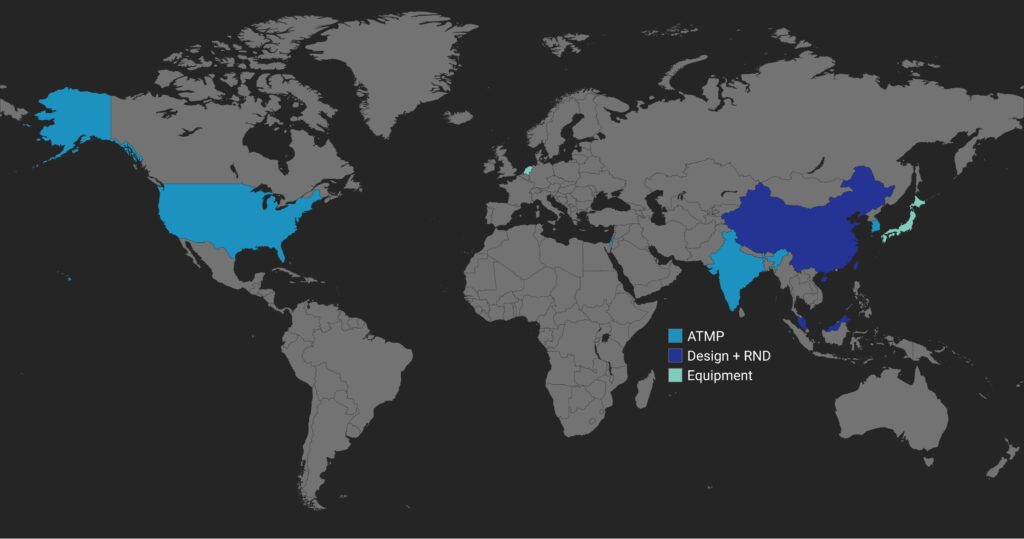
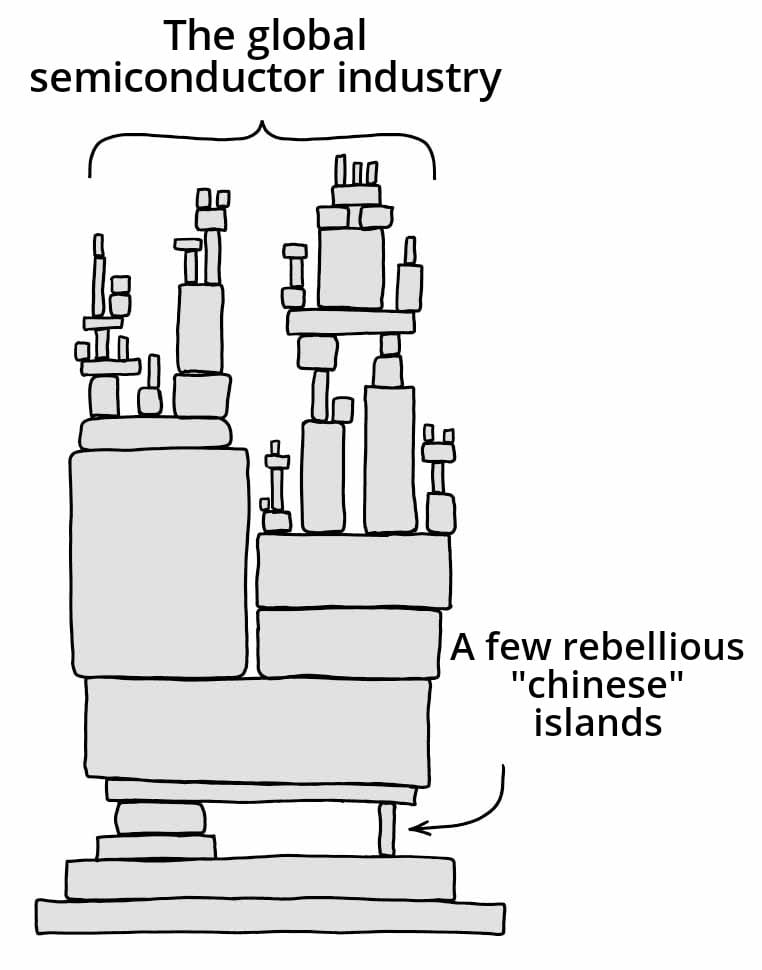
Clearly, it’s a pretty broken supply chain, and none of these countries have the capability to design, manufacture and assemble completely locally (yet). The heavy dependence on very few places for materials, equipment and processes means that if any issues, like geopolitical tensions (reminder that China and USA are pretty major stakeholders in the same pipeline :D), arise, the entire production has to stop, and there’s a shortage.
No government appreciates their perceived rivals touching their precious silicon chips, and they’re not wrong, considering how almost everything has a chip in it: from defense systems to pregnancy tests, to the device you’re reading this on. Add trade wars, the espionage that comes with it, and the AI boom, and you’ve got yourself an overpowered product no one wants passed around.
A beautiful example of such a shortage occurred from 2020 to 2023. COVID. The lockdown forced foundries in Taiwan to shut down during the time of online classes and work-from-homes, so while demand for semiconductors shot up, supply was down. This shortage was exacerbated when Taiwan got hit with droughts, leaving no pure water for foundries, and ended up affecting 169 industries, hitting the automobile industry the hardest, despite its requirement for more mature nodes (older technology, 180 nm+). That could’ve been supplied by a lot of other fabs as well. However, due to the insanely increased demand for chips designed for mobiles and PCs, coupled with the 5G rollout, there wasn’t much capacity left for automobiles. The demand for automobiles increased in the latter half of 2020, which also took the industry by surprise, as they scrambled to put new orders in.
Of course, no one likes a shortage, especially when it’s a major component hidden within your defense systems that you’re short of. The solution? Build a supply chain domestically, and if there are resources unavailable, only let your allies contribute. That was the plan originally with the “Fab 4 Alliance”, the strongest stakeholders in the semiconductor pipeline – Taiwan, South Korea, the USA, and Japan. However, Trump made some unhinged statements about the CHIPS Act, which involved removing subsidies, and instead placing tariffs on any company daring to import chips, all in the guise of increasing domestic production of chips (wouldn’t have worked btw, which is why it was never implemented). So, South Korea and Japan decided to have a little chat with China and try to resume free trade agreement negotiations, which resulted in Trump rescinding his statements and continuing with the act as it is. This is how soft power works. South Korea and Japan are well aware of how integral they are to the global semiconductor industry, and any move America makes against them can simply be countered by having little talks with their enemy, China.
More soft power!
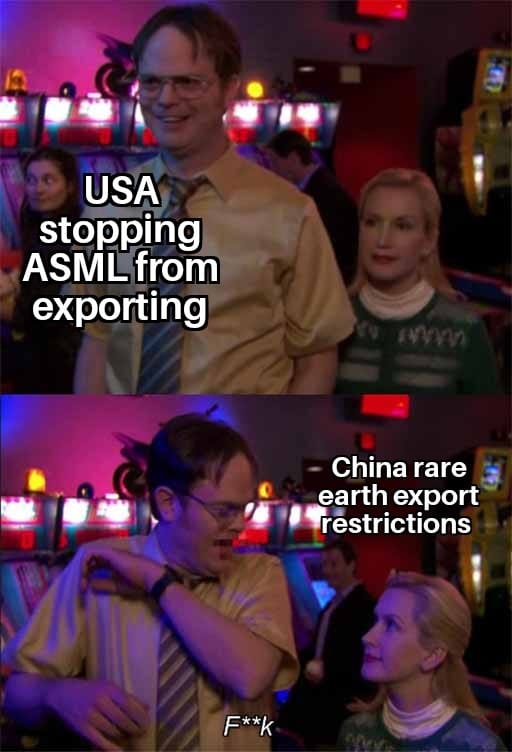
Technological advances have forever been exploited by nations and companies alike to forward their own motives in the form of soft power. Remember our special mention of ASML? They have a monopoly over EUV (Extreme UltraViolet) machines, meaning they follow the orders of the Dutch government (under the influence of US diplomacy), which banned the company from selling the machines to China. Without these machines, China cannot fabricate the complex chips they require for world domination (by which I mean not constantly hated on for being communist). These EUV machines are integral for making the patterns for very advanced nodes, since you’d require a great amount of precision in those chips (they’re tiny asf). Don’t worry though, they’re getting somewhat closer to making the machines on their own. They’ve acquired DUV (deep ultraviolet) machines, which aren’t as extreme as EUVs, but good enough for more mature nodes, and there is research ongoing for the EUVs. However, they try to make up for this by re-patterning the wafers several times, but it’s risky and not optimal for large-scale production. There exist other issues in the production, but this is a pretty major set-back currently, which holds China back (by a lot) from the world domination America is scared of (i.e. forcing America to share the stage).
My favourite example however, has to be Taiwan’s ‘Silicon Shield’. It is a theory that any attack on Taiwan by China will be countered by several other countries rushing to aid Taiwan in fear of the economic fall-out that would occur. Taiwan’s semiconductor industry in general is unmatched, with its exports accounting for 25% of Taiwan’s GDP, of which TSMC is a major part. TSMC is an insanely powerful player in the global pipeline, holding 54% of the semiconductor foundry market. Several parts of the US defense system contain TSMC-made chips (well, allegedly. Trump would riot if he knew his beloved military wasn’t completely American-made). They produce the most advanced chips (as of now: 3nm), among other various types of chips; for companies like Nvidia, Apple, and ARM. Taiwan exports these chips extensively to both the US and China, which makes any invasion by China into Taiwan quite costly, since China hasn’t really figured out how to fabricate cutting-edge chips on its own just yet (no EUV :(), and most major fabless firms in Silicon Valley are dependent on TSMC. Considering Taiwan is just a tiny few islands, with barely 13 nations agreeing that it is an independent country, it holds a hell lot of power. And it is a major frontline in the trade war between China and the US. If you’re curious about its position there, currently (as it has since forever), it is leaning towards the US, with TSMC aiding them to build fabs in Arizona under orders from the Taiwanese government, further proof of Taiwan’s alignment with the USA. The construction of the fabs isn’t going so well though. Something about foreigners stealing jobs that Americans weren’t qualified for.
India’s role in the process
So instead, why not go set up something in the aforementioned foreign place? You know, like how the US Space Force is now planning to set up a fab in India, along with 2 Indian startups, Bharat Semi and 3rdiTech, as part of the iCET framework (United States–India Initiative on Critical and Emerging Technology). Named ‘Shakti’, this plant is designed for national security and will manufacture compound semiconductors for defense systems. If construction starts, this will be the 7th semiconductor project the Indian government has managed to hold on to, the others being:
- Tata Electronics + PSMC (Taiwan): a commercial fab in Dholera, Gujarat
- Micron Technology (USA): assembly and testing unit for DRAM and NAND in Sanand, Gujarat
- Tata Semiconductor Assembly and Test: ATMP in Jagiroad, Assam
- CG Power + Renesas Electronics (Japan) + Stars Microelectronics (Thailand): ATMP in Sanand, Gujarat
- Kaynes Technology: ATMP in Sanand, Gujarat
- HCL + Foxconn (Taiwan): ATMP in Jewar, Uttar Pradesh
When you already have one part of the supply chain in your hands (yk, literally one-fifth of the global design workforce), might as well complete the entire pipeline, right? Except unfortunately, it’s not that easy. We kind of lack the skilled engineers that specialize in fabrication processes, testing, and packaging of semiconductors required to operate these plants (beta cs karlo), and the facilities in colleges to teach students these specializations. Colleges are reusing the same ancient curriculum as well, with no signs of updating, and showing a lack of interest in developing the infrastructure for lesser in demand branches. This creates a massive mismatch of the skill set the industry requires and the one students graduate with. Indian firms aren’t exactly keen on funding semiconductor R&D enough to attract professionals to stay either, resulting in them shifting abroad for more attractive incentives. However, honestly, the huge hype that the media is building over the new semiconductor projects makes the industry seem more attractive, never thought I’d be saying this, but props to Indian media! Maybe just focus a bit more on material and chemical engineering employment, and we’d be good to go.
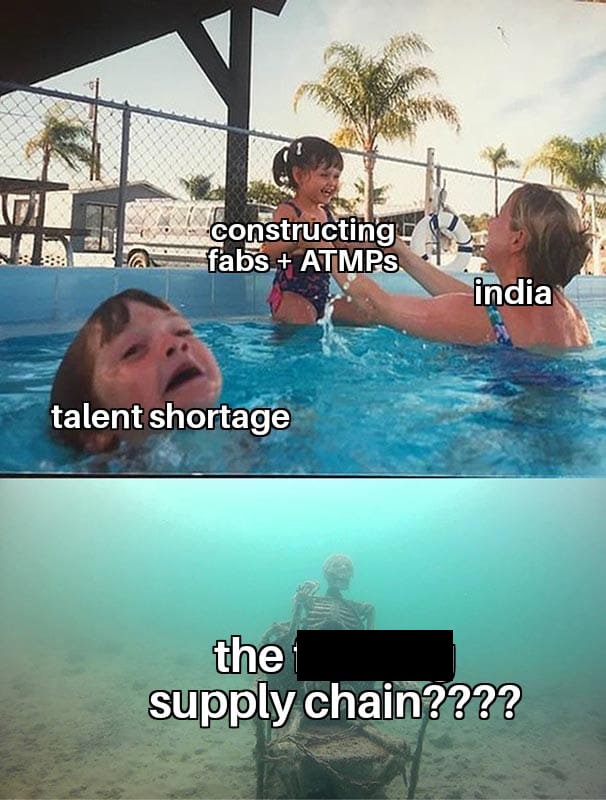
As for the skill set gap, there are industry-academia collaborations that help bridge the gap, such as the India Semiconductor Workforce Development Program, a collaboration between IISc, Synopsys, and Samsung, which is based on electronics (check it out!). There’s also ASCENT, a conference held by Applied Materials with researchers from top universities in India to collaborate on the more equipment and chemical side of the industry.
Other than that, there are plans to start Bharat Semiconductor Research Centre, located with the already existing Semi-Conductor Lab (SCL) in Mohali. This would be a public-private partnership designed to act as the RnD centre for the ATMP and fabs currently in construction, basically what SCL couldn’t be. However, as of May 2025, it’s been stuck in planning for a year, acting as a friendly reminder to follow up on random announcements of plans made by your neighbourhood netas :).
MeitY is also nudging higher-level institutions to develop more semiconductor manufacturing-based courses, potentially creating a tiny talent ecosystem. The talent shortage is a difficult problem to overcome, especially considering how several countries at equal and higher standings (Saudi Arabia, UAE, USA, even Japan and South Korea eventually!) are facing similar issues. It will require semiconductor firms to offer attractive incentives and knowledge transfers from well-established partners, and hope your locals don’t complain about foreigners stealing their jobs.
Heavy stuff, right? There’s another problem with the current ecosystem as well, though. Well, it’s the fact that no ecosystem exists in the first place. ATMPs and fabs require a lot of equipment and pure chemicals as supplies, which we haven’t exactly arranged for. However, the firms behind the projects do have plans of establishing this ecosystem with existing partnerships with equipment firms, like Tata Electronics, signing an MoU with Tokyo Electron. India also has a great chemical industry, which could be useful; we just need a few companies to pivot to more semiconductor-grade purity. Semicon Mission, the mission under which MeitY is approving the fabs and ATMPs, and providing these projects with funding and subsidies, has a phase 2 that is yet to be rolled out, which is supposed to deal with this exact pipeline problem. All we can do is hope that our government has some money left over for successfully conducting this phase (and the balls to actually see something to completion).
Despite the immense amount of funding and setbacks this entire mission will cost the government, and the several times they’ve failed before, India still seems hellbent on creating a semiconductor supply chain. What’s up with that? Well, for one, semiconductors are incredibly powerful and critical pieces of technology (if it wasn’t incredibly obvious by this point :p). It’s used practically everywhere: defense systems, automobiles, the phone/computer you’re reading this on. Being a part of the process of creating that incredibly critical piece gives India greater leverage on a global scale, or at the very least, considering our population, this would help put something Made In India in their phones. And well, Big Tech is trying to get as far away as possible from China due to the export restrictions the West has placed on it, and India seems close enough of a replacement. Even Trump’s tariffs can’t force them away from the sweet temptation of low labour costs and subsidies.
Now, there are a bunch of theories as to how far this could take India geopolitically. Some say India may manage to replace Taiwan if we manage to fix the employment issue. Others call bullshit and say this will likely foster a stronger alliance between the two instead. Considering India’s history of emphasizing collaboration between developing countries (us underdogs gotta stick together!), she could use semiconductors to increase her soft power over these nations, probably hoping to curb Chinese influence over nations like Sri Lanka. India’s reliability has already been confirmed by America with the planning of the Shakti plant, basically establishing India as a bridge to the Global South, or at least aligning her with the USA. Honestly, who knows, maybe China approaches India for collaboration on semiconductors, and together they overthrow the freedom-labelled American oppression over the world that has existed for far too long (for legal reasons, this is a joke).
Practically speaking, it is way too early to predict any major changes in international geopolitics that these projects will cause, nor are they being done with these long-term scenarios in mind. Big Tech jury is still out on India, and the projects are still in the construction and planning stages. We’ve just started out, and there’s a long way to go, but it should be an interesting journey nonetheless. (to me at least :p)
Anyways, if you’re interested in everything I mentioned above and want more, here’s a nice little reading list for you:
- https://itif.org/publications/2024/02/14/india-semiconductor-readiness/ – A “readiness assessment” to identify near-term industry opportunities, facilitate the longer-term strategic development of their complementary semiconductor ecosystems, and make recommendations to the U.S. Department of Commerce and the Government of India Semiconductor Mission (ISM). (im sorry im too tired to write this in my own words now)
- https://www.mckinsey.com/industries/semiconductors/our-insights/semiconductors-have-a-big-opportunity-but-barriers-to-scale-remain – details the issues with setting up semiconductor supply chains.
- https://www.mckinsey.com/industries/semiconductors/our-insights/how-semiconductor-companies-can-fill-the-expanding-talent-gap – a very interesting report on how the talent gap can be fixed
- https://iisc-iswdp.org/ – ISWDP website
- https://nsstc.niar.org.tw/en/highlights/analysis/india-semiconductor-chip – details the policies and steps taken internationally by India for semiconductors
tldr: ece good, cse bad, no i’m not chd why do you ask.


 AI Art
  Reels
Reels  Understanding Privacy – Case in Point: Aadhaar
  Data and IIIT
  A Twisted Way to Learn
 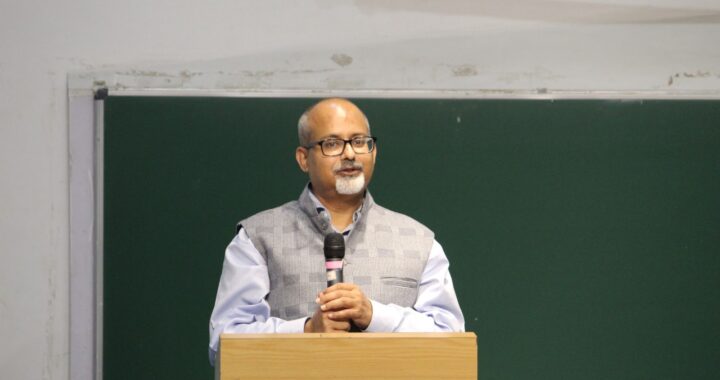 Beyond the Black Box: IIIT’s New Chapter with Professor Sandeep Shukla
  The Great Coupling
  PJN – Professor and No-Longer-Director
  The Lazy Third Eye: 2024-25 Annual Report edition